Strengthening Nonprofit Financial Oversight: Lessons on Reporting and Accountability
Disclaimer: This post may contain affiliate links. These links, if used and purchases made, we may earn a small commission. These affiliate programs do not impact the recommendations we make or the resources we refer you to. Our focus is on providing you the best resources for your nonprofit journey.
Most nonprofit leaders don’t set out to have weak financial oversight. It happens gradually. The founder handles the books because no one else will. The board gets a one-page summary instead of real financials. The annual audit keeps getting pushed back because “we’re too small for that.” Then one day, a funder asks a pointed question, a board member raises a concern, or worse, money goes missing. And suddenly everyone wishes they had built the systems earlier.Financial oversight is not about distrust. It is about building the structures that let your team, your board, and your donors trust you with confidence. For small and mid-sized nonprofits, the good news is that strong oversight does not require a CFO or a Big Four audit firm. It requires clarity, consistency, and a willingness to follow through.
Here are seven steps to build a financial oversight framework that actually works. Follow them in order, and you can go from ad hoc to accountable in 30 days.
Step 1: Audit Your Current Reporting Practices
Before you build anything new, take an honest look at what you have today. Pull together every financial report your organization produced in the last six months. This includes board reports, grant financial reports, internal budget-to-actual comparisons, bank statements, and anything else that touches money.
Now ask yourself some hard questions. Are reports produced on a consistent schedule, or only when someone asks? Do they follow a standard format, or does each one look different? Does anyone besides the person who created the report actually review it? Are the numbers reconciled to the bank, or are they just pulled from the accounting system and assumed correct?
Most organizations that do this exercise honestly will find gaps. That is the point. You cannot fix what you have not identified. Write down every gap you find. You will address each one in the steps that follow.
Step 2: Define Your Monthly Reporting Package
Consistency is the backbone of financial oversight. Every month, without exception, your organization should produce a standard set of financial reports. At minimum, this package should include:
- Statement of Financial Position (Balance Sheet) – Shows what you own, what you owe, and your net assets. This is the report that catches cash flow problems before they become crises.
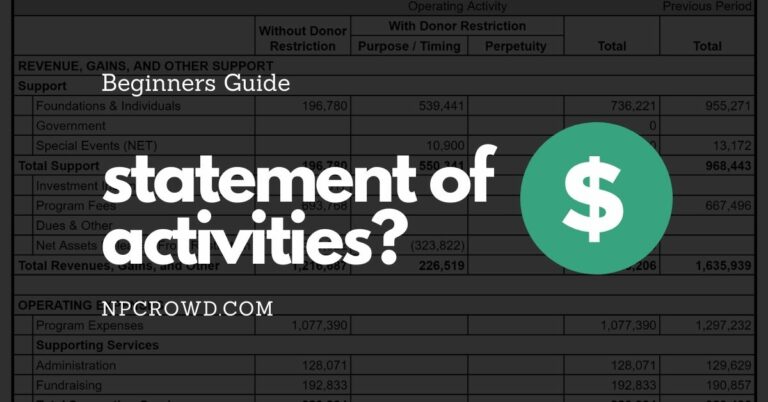
- Statement of Activities (Income Statement) – Revenue and expenses for the month and year-to-date, compared to budget. Every board member should be able to read this at a glance.
- Budget-to-Actual Comparison – Where are you over budget? Where are you under? What is the explanation? Do not just show the numbers. Include a brief narrative that explains significant variances (anything over 10% or a dollar threshold you set).
- Cash Flow Forecast – A rolling 90-day projection of cash in and cash out. This is the report that prevents the “we can’t make payroll” emergency that destroys organizations.
- Grant and Restricted Fund Tracking – If you have restricted funds, you need a report showing the balance, spending, and remaining availability for each one. Misusing restricted funds is one of the fastest ways to lose funder trust and invite legal trouble.
Set a firm deadline for this package. The 15th of the following month is a reasonable target for most small nonprofits. By the 10th is better if you can manage it. The deadline is not optional. Treat it like a grant report deadline, because the consequences of missing it should feel just as real.
Step 3: Build a Responsibility Matrix
One of the most common reasons financial oversight fails is that no one is explicitly responsible for specific tasks. “Someone should be reviewing the bank reconciliation” is not a plan. You need a responsibility matrix that names a person for every financial task.
A simple RACI format works well here. For each financial process, identify who is Responsible (does the work), Accountable (owns the outcome), Consulted (provides input), and Informed (needs to know it happened). Key processes to map include:
- Recording transactions in the accounting system
- Reconciling bank and credit card statements
- Producing the monthly reporting package
- Reviewing and approving the monthly reports
- Processing payroll
- Approving expenditures (and at what dollar thresholds)
- Filing tax returns and compliance documents
- Managing grant financial reporting
For smaller organizations where one person wears multiple hats, the matrix is even more important. It makes the concentration of duties visible, which lets you build compensating controls around it. If the same person records transactions and reconciles the bank, the board treasurer should be reviewing those reconciliations monthly. Write it down. Get sign-offs. Make it real.
Step 4: Draft a Financial Controls Policy
A financial controls policy is the rulebook for how money moves through your organization. If you do not have one, you are relying on informal norms and good intentions. That works until it doesn’t.
Your policy does not need to be 50 pages long. For a small to mid-sized nonprofit, a clear 5-to-10-page document covering the following areas will serve you well:
- Segregation of duties – Who can authorize payments, who can sign checks, and who records them? These should never all be the same person. If your team is too small for full segregation, document the compensating controls (like board review of bank statements).
- Approval thresholds – Define dollar amounts that require additional approval. For example, the ED approves purchases under $5,000, the board chair co-approves $5,000 to $25,000, and full board approval is required above $25,000. Set thresholds that match your budget size.
- Credit card and expense reimbursement rules – Who has cards, what are the limits, what documentation is required, and who reviews the statements?
- Cash handling procedures – If your organization receives cash donations (events, church collections, etc.), document how cash is counted, by whom, and how it gets to the bank.
- Document retention – How long do you keep financial records? The IRS recommends seven years for most documents. Your policy should specify this clearly.
- Whistleblower protections – Required for 990 filers and just good practice regardless. Staff need a clear, safe path to report financial concerns.
Once drafted, this policy needs board approval. It is a governance document, not an internal memo. Put it on the board agenda and get a formal vote.
Step 5: Strengthen Board Financial Oversight
Your board has a fiduciary duty to oversee the organization’s finances. But too many nonprofit boards treat financial oversight as “the treasurer looks at the numbers and tells us we’re fine.” That is not oversight. That is delegation without accountability.
Real board financial oversight includes several concrete practices:
- Every board member receives the monthly reporting package – Not just the treasurer. Every member has fiduciary responsibility, and they cannot exercise it without information.
- The finance committee meets monthly – If you do not have a finance committee, form one. Three members is enough. They review the reports in detail so the full board can focus on the big picture.
- The board reviews financials at every meeting – This should be a standing agenda item, not something squeezed in at the end if there is time. Allocate at least 15 minutes for financial discussion at every board meeting.
- Board members ask questions – If no one on your board asks questions about the financials, you have a problem. Either they do not understand the reports (fix the reports), or they are not engaged (fix the board). Train your board to read nonprofit financials. It is a two-hour investment that pays off for years.
- The board approves the annual budget – And reviews budget-to-actual performance quarterly at minimum. The budget is not a suggestion. It is the board’s financial plan for the organization.
Present your new oversight framework to the board as a package. Show them the reporting standards, the responsibility matrix, and the controls policy together. Frame it as strengthening the organization, not responding to a problem. Boards respond well to proactive leadership on governance issues.
Step 6: Choose the Right Tools
Good financial oversight requires good tools, but “good” does not mean “expensive.” The right tool is the one your team will actually use consistently. Here is what to evaluate:
- Accounting software – QuickBooks Online is the standard for small nonprofits for good reason. It handles fund accounting, integrates with banks, and every bookkeeper knows it. If you have outgrown QuickBooks, look at Sage Intacct or Blackbaud Financial Edge. But do not over-buy. A $500/month system you half-use is worse than a $30/month system you use well.
- Budgeting and forecasting – A well-built spreadsheet works fine for organizations under $2M in revenue. Beyond that, consider dedicated budgeting tools. The key is that your budget lives somewhere accessible and version-controlled, not in a file on someone’s desktop.
- Expense management – If you are still collecting paper receipts, stop. Tools like Expensify, Ramp, or even a shared Google Drive folder with a standard naming convention will save hours of reconciliation time and create a clear audit trail.
- Board portal – Your board needs a secure place to access financial reports. This can be as simple as a shared Google Drive folder with consistent structure, or a dedicated board portal like BoardEffect or Boardable. The tool matters less than the habit of using it.
When evaluating tools, prioritize integration over features. A system that talks to your bank, your accounting software, and your reporting tools will save more time than one with flashy dashboards that requires manual data entry. And always consider the transition cost. Switching accounting systems mid-year is painful. Plan tool changes for the start of a fiscal year whenever possible.
Step 7: Schedule Your Annual Audit or Financial Review
Many small nonprofits avoid audits because of cost, and that is understandable. A full audit can run $8,000 to $25,000 depending on your size and complexity. But external review of your financials is not optional if you want to be taken seriously by funders, regulators, and the public.
Here is how to think about it:
- Under $250K in revenue – A compilation or agreed-upon procedures engagement may be sufficient. Cost is typically $2,000 to $5,000.
- $250K to $750K in revenue – A financial review (not a full audit) gives you an external CPA’s assessment at a lower cost, usually $3,000 to $8,000.
- Over $750K in revenue – You likely need a full audit. Many states require it at certain thresholds. Check your state’s requirements and your funder agreements.
- Receiving federal funds – If you spend $750,000 or more in federal awards in a year, you are required to have a Single Audit under the Uniform Guidance. No exceptions.
Do not wait until a funder requires an audit to get one. Start the relationship with a CPA firm now. Ask peer organizations for referrals. Look for firms that specialize in nonprofits, because they will understand fund accounting, 990 preparation, and the unique compliance requirements you face.
Schedule your audit at least three months before your filing deadline. If your fiscal year ends December 31, your auditor should be starting fieldwork by February. Build this into your annual calendar and treat it as non-negotiable.
Your 30-Day Financial Oversight Implementation Checklist
Week 1:
- – Audit current reporting practices (Step 1)
- – Define your standard monthly reporting package (Step 2)
- – Set the monthly reporting deadline and communicate it
Week 2:
- – Complete the responsibility matrix and get sign-offs (Step 3)
- – Draft a Financial Controls Policy (Step 4)
- – Implement segregation of duties or board oversight workarounds
Week 3:
- – Present the new oversight framework to the board (Step 5)
- – Get board approval of the Financial Controls Policy
- – Evaluate and select tools if current ones are inadequate (Step 6)
Week 4:
- – Produce your first standardized monthly report package
- – Schedule annual audit or financial review (Step 7)
- – Calendar recurring dates: monthly reports, board financial reviews, annual audit
Financial oversight isn’t a one-time project – it’s an ongoing discipline. But the framework above gives you everything you need to go from ad hoc to accountable in 30 days. Start with Step 1 today, and build from there.
? Deep dive: See our complete Nonprofit Salary Benchmarking Guide for data-driven compensation strategies.
Compensation questions coming up? Be ready.
Whether it is a board review, a new hire, an audit, or someone browsing your 990 – ExemptPay helps you respond with data. Explore free salary benchmarks from 3M+ Form 990 records, then generate a Board Confidence Report with peer group analysis and minutes-ready language your board can act on.



![21+ Nonprofit Management Certificate Programs [Best List]](https://npcrowd.com/wp-content/uploads/2021/08/Nonprofit-Management-Certificate-Programs-Best-List-768x402.jpg "21+ Nonprofit Management Certificate Programs: Best List 5")